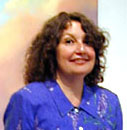
This book calls for a grand backdrop, a vista of possibility.
For some time, a neglected item on my TO-READ list (which curiously gets longer, never shorter--when I last unfurled it, my list was rolling down Highway 285 towards Clines Corners), has been Becoming Whole by Meg Wolff. I am very pleased to report I have not only read Becoming Whole by Meg Wolff, I am going to recommend it to you. But please do no ask me to loan you my copy. It is one of those inspiring reads that I will want to keep handy, the kind of book I can open randomly, to any page, on a dark day, and find something uplifting. Apparently, I'm not the only one who feels this way. Becoming Whole is highly recommended by two of my heroes in the world of healing, Christiane Northrup, author of Women's Bodies, Women's Wisdom, and Bernie Siegel, author of Love, Medicine, and Miracles.
Becoming Whole is Meg's startling, honest account of her journey through an entire decade of dealing with cancer--bone cancer, then further down the way, breast cancer. It is a descent into a personal hell few would emerge from. Along the way, Meg relinquishes her left leg, her right breast, her hair (of course), her self-worth, her confidence in her own body, and ultimately her connection to the Earth itself. She observes the heart-wrenching pain of children frightened of losing their mother, and she fantasizes about buying presents for them to unwrap on the birthdays she will not be a part of. Meg and her husband become strangers sleepwalking through a life that has been reduced to endurance. She privately selects a future wife for her husband, a mother for her children--a beautiful, kind friend who is going through a divorce.
Sounds like a difficult read, no? Yes, part of it is. The candid descriptions of various medical procedures--from chemo to radiology to amputation to partial radical mastectomy--the various, grisly wounds inflicted on this beautiful woman's body--these descriptions are in themselves very painful to read, as are Meg's observations of the emotions she experienced:
For weeks after the surgery, I was conscious of my deformed body. Everyone I encountered seemed to present the image of what a human being should look like. People should have two legs; women two breasts. I watched people move effortlessly as they crossed the street, or walked along sidewalks. I noticed mannequins in dress shops and photographs of women in magazines. Soon I realized that I must not watch television or read magazines, because they stressed the importance of women's figures, and insisted that these images were what women should be. I no longer measured up.
One cannot read Meg's story without feeling anguish, and even more so, anger. Make that furor. Furor at the arrogance of many of her doctors, furor at the fragmented vision of contemporary medicine, which focuses on poisoning the body in the name of curing disease, a medicine which can identify sickness but not health, a medicine in which doctors do not listen to patients. (Unbelievably, Meg suspected her cancer years before she received a diagnosis. Both times. She was condescended to, receiving the message she was a hysterical worry wart.) A medicine which breaks the essence of its own Hippocratic oath--Above all, do no harm. A medicine which all too often is detoured into costly, dangerous procedures because of the profit to be obtained. As Meg so succinctly puts it when one doctor insists she endure a bone marrow transplant procedure, which now, years later, is known to have killed women rather than saved them:
I had enough experience with doctors to spot a medical salesman when I saw one, and Dowd and the cancer institute physician were more entrepreneurs than healers. They saw my expensive health insurance card and knew that I could pay for the treatment. Something told me that that's what mattered most to them.
And so Meg begins to trust that soft-spoken, wise voice within, to trust the healers who are themselves humble and respectful. Sometimes these are traditional doctors of medicine. Other times they're alternative healers or macrobiotic chefs or massage therapists.
And that turning point is the juncture at which Meg begins to embrace life rather than seek to prolong it. She subsequently "just says no" to tamoxifen treatment, despite a doctor's urging that this is her last hope to eke out a little more time in this life. Her intuition tells her tamoxifen will kill her. Or at the very least render her helpless:
Who would take care of me when I had a stroke? Would Dr. Wingate take responsibility for me after I had become incapacitated and lay dying in some nursing home? Whose life was this anyway?
Indeed.
That was better than ten years ago. Meg has taken ownership of that life, and of the body inhabited by that life. She has been medication-free for all of those years! All of her medical tests indicate that her body has been restored to perfect health. Meg herself is the proof. She attributes her vitality to having undertaken the macrobiotic way of eating and living, a way of living which is balanced and attuned to nature. A way of "living large." MACRO biotics. Get it?
Maybe not.
That's why Meg has written Part Two. Part Two is devoted to a thorough explanation of the hows and whys of macrobiotic eating, pages of meal plans, and delectable, exotic recipes. Think of a a graceful dance between yin and yang. Think of the color balance in a beautiful painting, or in fresh foods arranged on a plate, bursting with life force. Think of an opening to life itself, saying yes! to all that matters and brings pure joy.
Does Meg feel bitter about all of those years lost to cancer and dead ends, the tragedy of Part One? I'll let her answer that question:
One day that spring, while cutting vegetables by the open window of my kitchen, I suddenly had a strange and surprising thought. I had cancer to thank, and all the trials and tribulations that accompanied it, for helping me to banish my fears, find my voice and mission, and find--really find--happiness.
This book is for anyone who suffers from dis-ease, physical or emotional. Anyone who has ever looked back at a wrong decision and thought, Hey, I knew better than that! Why did I listen to an authority figure rather than my own wisdom? Anyone who feels remorse or anger or bitterness. Anyone who's lost confidence and feels powerless. Anyone whose connections have disappeared--with family, or the body, or the Earth. In short, anyone. Becoming Whole is available at Meg's blog.